Kürzlich hatte ich eine gute Diskussion zum Einsatz von LLMs in der Software-Entwicklung, die eine gewisse Differenzierung erlaubte. Derzeit werden Diskussionen rund um den Einsatz sehr schwarz-weiß geführt – ich komme von der AI-kritischen Seite und Argumente rund um Ressourcen-Verbrauch, Finanz-Bubble, Ausbeutung, Sicherheit, Psychosen, Slop sind hiermit acknowledged, werden in der folgenden Betrachtung, aber nicht noch einmal aufgegriffen.
Im Einsatz von LLMs unterscheide ich zwischen zwei Arten: Ist das LLM eine Funktion innerhalb eines größeren Prozesses oder steuert das LLM diesen Prozess. Macht du Bildbearbeitung und nutzt in deiner Software ein Feature zum sauberen Markieren eines Object, ist es Ersteres. Du könntest es ohne AI machen, ist aber mehr administrativer Aufwand, der kreative Prozess liegt bei mir. Du hast eine Automatisierung, die deterministische Schritte geht und ein Schritt ist ein Prompt zu einem LLM, ist ebenfalls Ersteres, solange das LLM eine einzelne klare Funktion, zB eine Qualifizierung erfüllt. Zweiterem entspricht der Ansatz “mach mir alles”, wenn der kreative Prozess an sich an das LLM abgegeben wird. The Oatmeal hat das schön zusammengefasst.
Ähnlich sehe ich es auch bei Software-Entwicklung. Du kannst einen sehr gezielten LLM Einsatz haben, der an den richtigen Stellen sehr hilfreich ist und eine gute Ergänzung ist. Für mich ist dass, wenn ich komplexen Code debuggen (stell dir 5x verschachtelte SQL vor und frag nicht woher die kommen) und das LLM erstaunlich oft ihr beschriebene Fehler auflösen kann. Meine Erfolge mit Coding Agents sind dagegen gering, was hauptsächlich daran liegt, dass ich sie mit lokalen Open-Source LLMs und zu schwacher Hardware betrieben habe.
Ich war letztes Jahr zu einem n8n-Meetup. N8n nutze ich öfters, wenn es darum geht schnell Automatisierungen zu prototypen. Umgeben war ich von Marketing-Personen und Product-Manager*Innen, die stolz ihre selbst gebauten Systeme zeigten. Automatisierungen wild zusammen geklickt aus 5 Services ohne Rücksicht auf Performance, Datenschutz, Skalierbarkeit und Stabilität. Aber sie waren stolz drauf und es erfüllte für sie eine Aufgabe, die vorher nicht erfüllt werden konnte. Was in der Luft schwang, war eine Abwertung der eigenen IT-Abteilung. Du hörtest den Frust von Menschen, die zu oft “nein, machen wir nicht”, “nein, keine Ressourcen” oder “wir setzen es aufs Backlog, du hast es in 4 Monaten” zu hören bekommen haben. Ihnen ist egal, dass ihre AI-Lösungen alle paar Wochen zusammenbrechen und ein Datenschutz-Albtraum sind.
Im Product Management gibt es eine Organisationsmethode von Flughöhen (Flight levels). Du kannst Initiativen in verschiedenen Flughöhen haben, die alle hohe Prioritäten genießen, aber unterschiedliche Zeithorizonte haben. Die Quickwins auf niedriger Flughöhe sind schnell eingeführt, lassen sich schnell ändern und können schnell wieder ersetzt werden. In der mittleren Flughöhe sind Themen mit Blick auf das nächste Projekt, die über die nächsten Wochen/Monate relevant werden. Die strategischen Themen sind oberste Flughöhe und die dicken Bretter. Diese ändern sich selten und haben einen langen Zeithorizont.
Software kann ebenfalls in diese Flughöhen eingeteilt werden und je nach Höhe kommen unterschiedliche Anforderungen. Dein Einmal-Script von der AI geschrieben, dass du nicht wieder verwenden willst ist ein Quickwin vorausgesetzt es ist bei unkritischen Dingen im Einsatz. Die vibe-gecodete Anwendung ist eine nächste Flughöhe mit überschaubarer Lebensdauer aber praktischem Nutzen. Es wird oft kaputtgehen, aber das macht nichts. Es hilft dir, niemand anderen und du kannst die Verantwortung für dich tragen. Die nächste Höhe ist Software, die mit Zugriff auf das Lethal Trifectar – Private Daten (Kreditkarte), Zugriff ins Internet(kann Daten zu Webseiten schicken) und Zugriff durch Unbefugte (LLM führt Inhalt einer E-Mail aus) – hat. Hier erreichen wir den Punkt an dem Vibe-Coding nicht mehr empfehlenswert ist und wo LLM-Einsatz nur noch in isolierten einzelnen Funktionen sinnvoll sein könnte. In der höchsten Flughöhe ist die Software das Zentrum deines Businessmodells. Soll sie für Jahre stabil und skalierbar sein, so halte LLMs davon fern. Hier spielen Architektur, Software-Design, Performance und langfristiges Komplexitäts-Management eine große Rolle und können hier nicht LLMs nicht mithalten.
Nach diesen Flightleveln bewerte ich für mich, wann welcher AI-Einsatz tolerabel ist. Kenne deine Werkzeuge, deine Risiken und wann du einen Bogen drum herum machst.
In my first article, I looked at Generative AI delivering the Plausible Looking Answer. I did not go into the mechanisms of how Large-Language-Models work. This time I’d like to layout how understanding their technology also helps understanding their short-comings and reduces anthropomorphizingthemover and over. Let’s try and have a look into the machine.
Two phases, two layers
To talk effectively about it, we have to look at two phases of working with the Large-Language-Model.
The first is the training phase in which LLM providers feed as much data as they could get their hands on into the model. The training takes months, a-hell-of-a-lot of (copyrighted) data, energy and cooling water. Once training finished, the model is frozen and made available to use by in or by other services.
Once the model is running, you have the first layer of your AI-service – its foundation, hence “foundational AI model”.
The model itself is frozen and state-less. You send it an request and it will generate an answer. It will not learn on or store your input, your prompt. It will not “remember” what you did a minute ago. To achieve something like short-term-memory, we need to build something on top in the application layer. This layer orchestrates between user inputs, access to additional resources, prompting the LLM. receiving and displaying its response. Much of what happens in an AI-services is not in the actual LLM, but happens in the application layer. We will go deeper here at a different time.
The orchestration also makes the model start generating.
Wakey wakey
The lifecycle of an AI request goes through the same three steps continuous steps: the LLM is state-less program running on a server. The server idles waiting for a request, upon receiving a prompt, the server asks the LLM to generate a response – streaming it piece by piece. Upon finish, the server goes back into idle – the LLM not performing any action. Why is it streamed piece by piece? In an attempt to make waiting times of slower models feel shorter.
If you don’t prompt it, the server sits on stand-by. Without a prompt, the LLM is not neither “thinking” nor “resting”. It will not have a spontaneous idea and “wake up”. The LLM behaves like any other server, waiting to be called. The prompt-response-pattern is at the core of every AI service.
Averaging the human knowledge
The process of creating and training a Large-Language-Model is complex and my explanations will be simplified to get the gist.
Training can be [split into more steps](https://magazine.sebastianraschka.com/p/new-llm-pre-training-and-post-training) (Pre-training, Post-Training, Finetuning, etc) but for us the *Pre-Training* is the most important.
What is this Pre-training? It’s the GPT in ChatGPT (Generative Pretrained Transformer). Today’s LLMs are trained over months on all text, books, websites, movie scripts and movies. These have been broken down into Tokens. Instead of “Daniel” or each letter “D”, “A”, “N”, “I”, “E”, “L”, my name has been tokenized to “Dan” & “iel” and during pre-training the algorithm found, that after the token combination “Dan” and “iel” the tokens “Rad”, “cli” & “ff” are slightly more likely than “Sen” & “ff”. The same, but technically more complex happens when building models for audio or video, which are trained on audio, images and video as well.
Remember when I said in part 1 “No words have meanings to LLMs. To an LLM it’s all just symbols”? These tokens are the symbols. They hold no semantic meaning, they are the pieces for computation and for the statistical analysis.
Nothing the model was trained on is actually stored. It is one giant fuzzy database of parameters encoding the statistical relations between tokens and approximating the original data.
I just said approximation, because during training the original input has been compressed into these parameters with losses. It’s more like a vending machine: you select a product, the machine translates your input into the row and column of your choice, but you don’t know which exact article you will get. When selecting Cola, you may get regular Coke, or Diet Coke, or Cola Zero, or Pepsi. It all fits the original request, but something got lost on the way.
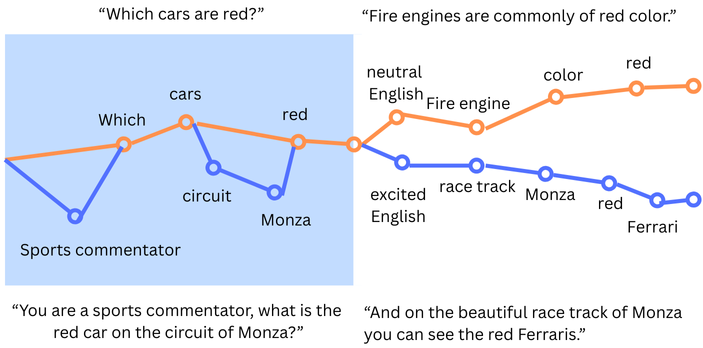
It’s not easy to imagine a multidimensional space of parameters describing an approximation of language and knowledge, so we won’t. We’ll stick with two dimension and look at an example.
This is fundamental to all LLMs, you pass the initial prompt and it responds with a plausible extension. What’s happening is that your prompt basically draws a path through the model’s billions of parameters and based on this path, it begins generating a response, that itself can go down many different paths.
By changing your prompt, you implicitly describe which parameters get activated in your response. If you ask “Which cars are red?” it may draw a very straight-forward path between the statistics of the word “which” and the word “car”, with a detour through “English language” and may return a response like “Fire engines are commonly of red color.”. Change the prompt to “You are a sports commentator, what is the red car on the circuit of Monza?” the path will also lead though the topics “sports commentating”, “motorsports”, “Monza circuit” and you get a high likely how that “red car” gets related to “Ferrari” in the resulting response “Red cars on the race track of Monza are often Ferraris.”.
Based on this behavior many prompting-strategies have been developed, where providing very specific context can direct the LLM through topics that vastly improve the quality of the response. However no matter the prompting strategy, the LLM will always generate the most plausible path through its data. The generated answer is always an hallucination – just sometimes more correct than other times. It produces text without intent, without interpretation, without malice, without “understanding”. It’s only statistics. The machine is always guesses a text without understanding its meaning, it sees the tokens and attempts to guess an answer from statistics. And sometimes, its guess is right.
Personally, I prefer to avoid the term “hallucination” as it is a euphemism for LLMs producing text which does not stand fact-checking. It’s a machine doing what it is supposed to do, but it is sold by AI providers as more than it can fulfill.
Think harder!
Some LLMs have been extended to work as “Reasoning models”. These add another processing step when generating answers. This is called “thinking”, and can be thought of as an extension to Train-of-Thought. The model will first generate itself a new prompt, that is then being used to fulfill the task. By thus covering a wider context and laying a more detailed path through its data, the hope is to cover more ground and improve the final generated result. This comes at the price of lower response times as the model has to generate even more text, using more tokens and spending more energy.
When addressing these criticisms of wrong responses being hallucinated AI-fans often respond, that this will be fixed in the future and it will get better. The truth so far is is: It will not, as it’s not possible by design with the current technology. Hallucinations are inherit to the design and for the past two years AI providers worked hard to circumvent the most obvious ones on the application layer through moderation. They can’t fix every specific cases on training in the model. Models have mostly grown through data size and scaling, with lower return-of-investment, the bigger they get. Some people already ask, if they have become as good as they can get.
Summary
Whatever you ask your LLM to generate. It will always generate its response from its training data, its corpus. It will recombine, but is it creative? It will not remember, have meaning or understanding. In training any creativity and heart will be averaged out into a statistically plausible response. It will not have creative new “thoughts”. It will walk paths many people before already walked on. It will respond to the next person prompting a similar question with a similar result.
Recombination can bring new ideas and creativity is often a recombination of familiar elements in a new context. To achieve this, you need an understanding of its meaning. Good prompting can lead the model to be a helpful tool, but recognizing creative ideas requires judgement by a human being in front of the keyboard. LLMs produce language, not content. This is where slop is born. I’m reminded of a quote by Kevin Sands, “It is never the tool that decides. It’s the hands-and the heart-of the one who wields it.”.
As such AI can serve as a multiplicator. If you are creative, AI can be one more tool in your toolbox to achieve cool things. If you don’t bring the initial skills, it will make your work look like everyone else’s. If you feed your text into a generative AI to have it reworked, you are literally asking it to remove your personal touch and make it more average and less yours.
Using AI does not make you stand-out, it makes you blend in with everyone else using it.
Generative AI based on Large-Language-Model (LLM) is here, but most people have a vague understanding on what this black box is – how it works, what to expect. This is fine, you don’t have to understand how a solar panel works for getting electricity. However it is important to have an idea of the technology with certain expectation. Generative AI seems like magic when in reality it is all statistics. It looks like human thinking, sensing and feeling, when it is playing pretend. Explaining how LLMs work technically is interesting and also tough, but you can still find some mental images that help to set expectations of what this technology can do and how it operates.
My fallible friend
Your generative AI is like an eager friend. You can ask them any question. They will always have an answer. They will rarely say, “I don’t know” and will bullshit or even gaslight you into thinking, they do have the answer. Oftentimes they are right, but being right yesterday is not indication they will be correct today. Whether they are correct or wrong, or whatever, you only know once you check or question their response. Until it is checked, the response is only plausible.
Sentence completion turned to 11
We all have used the keyboards on our Smartphones. Above the virtual keys, you get a word prediction, where the system tries to anticipate your next word, so you don’t have to type it out. This is partially trained by your typing and reflects common word combinations you may have used. For years, on social media people played with predictive texts. You’d start a sentence and have the word prediction on your phone keyboard complete it. Generative AI and Large-Language-Models just like this, but on steroids. The interaction is always a call & response. You pass a prompt and the LLM will auto-complete your prompt with a plausible looking response.
Plausible looking responses
Much discussion is about LLM responses being correct or false, but these are words, that have no meaning to LLMs. No words have meanings to LLMS. To the LLM it’s just symbols. LLMS have no thinking, no sensing, no concept of reality, of right or wrong, of fiction and non-fiction. LLMs are statistics trained on the internet with all biases, short-comings, copyright-infringements, and grammatical mistakes, there are. The more context you provide, the better its calculation may pass an answer that not only looks plausible, but is actually correct. You can ask an LLM, what the name of the first city on the moon is. If it says “New Berlin”, it gave you the answer from Star Trek. Technically not wrong, not totally correct either.
Similar when you ask for sources. The LLM will always try to create a plausible looking answer. In the answer, you’d expect a list of book titles. Having book titles makes it look more plausible than saying “I don’t know any books of that topic.” Thus it invents book titles, to make a more plausible looking answer.
On a limited scale, you can influence this with your prompt and the AI providers try ensure good looking answers, but this is a fundamental characteristic of the technology. It will generate plausible looking answers.
Hallucinations
When marketing departments companies pushing AI found that too many would generate garbage or fudge details, the term “hallucination” was coined. “Ah, the model is just hallucinating, it’ll improve in the next version”
Hallucination is not the failure of Generative AI, it’s the mechanism by how it works. It’s the statistical recombination that creates a plausible looking answer, given the initial prompt.
It looks like thinking
“But look the train of thought, it’s thinking, it’s reasoning!”
Train of thought is the method of asking the LLM to write down “what are the steps you would do to solve X”. Again, the result will be a plausible looking sequence of steps, but it’s not “thinking” and it’s not the steps the model will actually perform. It’s a generated answer describing the steps. Similarly, when you posed a question to an LLM and ask it “how did you do this”? It will generate a plausible looking answer, describing what a thinking process may have looked liked, but it didn’t think this process, neither has it memory. Apple recently published a paper going into more detail. If you ask a model “how do you feel, what do you want”, it will either respond with a plausible looking answer about being self-conscious and may sound very human doing that, but it’s still only a plausible looking answer. Many AI providers also tweaked their models, to respond to these kind of questions with template answers as too many – even experts – fell into the whole of believing to have found sentient AI. This is Pareidolia.
Doing Chain of Thought when prompting LLMs, it did show improved results by the AI’s response. What it does do is asking the LLM to cast a slightly wider net in it’s training data, thus getting a bit more context from the prompt, extending the level of detail to a degree where the generated response has more context based on fetched trained data and a higher chance of being correct.
How this breaks down can be nicely seen when asking math questions, or counting letters in a word. It doesn’t think, it generates plausible text. “How many letters are in strawberry?” A structurally plausible answer is “There are 5 r in strawberry” – there is no model of a letter, there is no model of a word or of the process of counting. It just knows, that in its billions of training data, statistics show, that a plausible answer looks like this. Applying train of thought, will have the LLM describe how letters are counted, but since it does not actually perform the steps it describes, it may still fail.
The strawberry example has been around long enough, that newer models were trained on articles describing this behavior. They may now return the correct number for strawberry, but now ask for blueberry and they may fail again. Similarly, when you ask to “generate a sentence of exactly 25 words” or “count the elements in this list”.
Summarize all the things
A common generative AI use case often presented are summaries. “Have this e-mail summarized for you!”. Unfortunately it doesn’t summarize. When you ask LLM for a summary, or a transcript, you will have one of two situations.
If the document you want to get summarized is about a topic, that is well documented and included in the pre-trained corpus of your model, when generating the summary it will draw heavily from this trained data and add “outside” knowledge to the document. It may add points not included in the original document, but which may be “plausible” to add. It’s like asking an intern to summarize a document and they will give you the Wikipedia summary.
If the document is on a topic not reflected in the corpus of your model, it can not draw from the training data, so it has to work with what you have given it. In this case, it will analyse the source document and make a statistical guess on what is imported in the document. This would be your intern counting how often the word “opportunity” was mentioned in the document and thus only mention the opportunity, while leaving out the risks because the word “risk” was only mentioned once. Can’t be that important, right?
Your AI friend can help you, or it can fail. Depending on the quality of the model, it can fail hard and invent everything in the quest for the most plausible answer. I know people talking about “human-level AI” to address this. AI is not infallible, it’s only “human-level”. I gave my sister the same explanation, on how LLM don’t do summaries. Her response was “still better than my colleagues”, mine “Get better colleagues”.